
When I was a manager at a retirement village, there was a short period when I would go regularly over to Mr Sato’s house in Villa 27. I have known Mr Sato for many years, going through many stages of his ageing. When I started my regular visits, Mr Sato had recently lost his wife. He had dementia and was barely able to keep living independently in his house. With in-home support services however, he was still there.
We would chat for long periods, and he would usually tell me the same stories he told me the day before, and not remember that he had told me. I would tell him the same things I told him the day before, and there would be no signs he recalled I had already said them. We both would laugh at those stories, sometimes we would be sad about something in his past he regretted. On his patio, we spent many hours.
Each day when I leave his home to return to my work for the day, I would write in his notes that I had visited him. Besides dates and times, there was rarely anything new to add. I cannot determine that being with him helped his dementia, or slowed his decline. We talked about the same things, in almost exactly the same way. Most of the day’s occurrence would be wiped from his memory by the time I returned the next day.
And yet, I felt the visits was not a waste of time. It was what our relationship called for. It was when we recognise each other’s dignity as human beings.
I have told this story to many people before, and asked the question, “Did I waste my time with all those visits?” Almost universally the response is the same: of course those afternoons were worthwhile.
Yet when I asked why, we found it surprisingly difficult to come up with answers. If they achieved no clear outcomes, why did they feel so deeply worthwhile? It is one of those things I believe as humans we can feel and experience, but languages and words have not caught up with.
One possible reason for the anomaly is that we perhaps grew up learning to explain our actions by pointing to the results. Actions are justified by answers to questions like: What did we achieve? What did the actions produce? Did they make someone better?
Those are good questions. It lead us to many human advances. Most of the resources I enjoy is because people before me asked those questions.
But they are not the only questions human beings asks. The majority of human life is lived beyond those questions. During times when we sit with a dying parent, when we listen to a child who discovered something new, when we share a meal with someone, when we play music together, when we write in a journal no one else will read, or when we sit quietly with a cup of coffee.
These are times when optimising for an outcome is not the point. We live them, be present and immerse ourselves in the experience of encounters, relationships and formation.
Raising children is one area that requires an enormous amount of deliberate optimisation for outcomes. A parent has to ensure our children are safe, healthy, educated, and meeting development milestones. A lot of functional planning and actions go into organising schedules and attending appointment. We research schools and extra-curricular activities. We engineer opportunities for them to spend with their loved ones. We work on earning income, to budget and make wise decisions with their resources.
Raising children is like that. But I have also come to realise there is much more to the experience of parenting than that.
Recently I was driving my kids home after their weekly dance lesson, with them in the back seat. We knew where we were going. I knew how to drive. There was nothing to solve.
Somewhere behind me, they quietly picked up my phone and took this photograph.
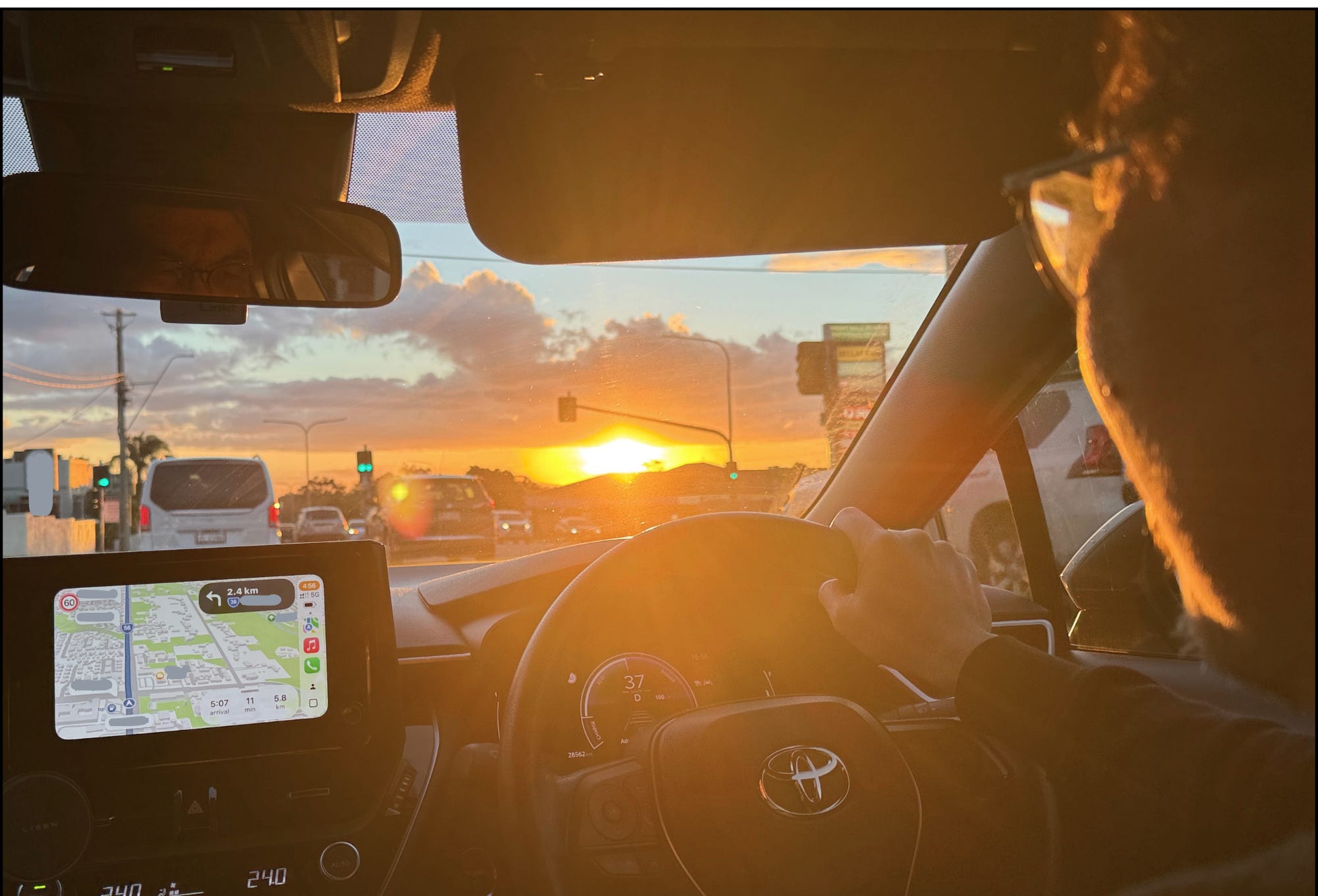
I don’t remember what we talked about. Perhaps we hardly spoke at all. But they noticed the sunset the same time I did. They wanted to keep the moment. That’s now one of my favourite photographs.
I can’t point to what our car rides achieved, beyond the outcome of getting from point A to point B. It didn’t improve their grades. It didn’t make them healthier. It didn’t teach them measurable skills.
If we had a teleportation machine, would I have used it and got rid of the car rides? Most definitely not. The car rides were never merely about getting from one place to another.
I wonder if we have become so accustomed to asking about outcomes, we forget other questions:
What kind of human beings are we? What are we present for? What kind of people are we together?
Perhaps those ordinary moments are not interruptions to the life I am striving to accomplish. Perhaps they are my life.
Perhaps there is something in sitting with Mr Sato on the patio at Villa 27.
Note: The name Mr Sato and some identifying details, have been changed to protect the person’s privacy.
Thanks for pointing this out. I feel like something is missing in my life in spite of having so much.